Cavity in Milk Teeth: Causes, Symptoms & Treatment
Learn what causes cavities in milk teeth, the signs parents should watch for, treatment options, and ways to help prevent tooth decay in children.
On this page(14)
- What Is a Cavity in a Milk Tooth?
- Why Do Cavities Develop in Milk Teeth?
- What Does a Cavity in a Milk Tooth Look Like?
- Symptoms of Cavities in Milk Teeth
- Are Cavities in Milk Teeth Serious?
- When Should You Take Your Child to a Dentist?
- How Is a Cavity in a Milk Tooth Diagnosed?
- How Are Cavities in Milk Teeth Treated?
- Does Every Cavity in a Milk Tooth Need a Filling?
- What Happens If a Cavity in a Milk Tooth Is Left Untreated?
- How Can You Prevent Cavities in Milk Teeth?
- Common Myths About Cavities in Milk Teeth
- Cavity Treatment for Children at ESD Dental Clinic
- Frequently Asked Questions
Many parents find out in a quiet moment: a chalky white patch near the gum, a brown or dark spot on a back tooth, a small hole that was not there last month. Sometimes there is no visible change at all. A child simply starts chewing on one side, flinches at cold water, or complains that food keeps getting stuck in the same place.
Any of these can point to a cavity in a milk tooth. Baby teeth can decay just like permanent ones, and they still do real work for as long as they are in the mouth. This article walks through what is usually happening, what to look for, when a dentist should take a look, and how treatment is decided. It cannot diagnose your child's tooth, but it can help you know what to do next.
What Is a Cavity in a Milk Tooth?
A cavity is a damaged area in a tooth caused by tooth decay. It starts when bacteria in dental plaque, the sticky film that builds up on teeth, feed on sugars and produce acids. Those acids slowly dissolve minerals from the tooth surface. At first the enamel only weakens. Over time, if the process continues, it can break down and form a hole.
Milk teeth have thinner enamel than permanent teeth, so once decay develops, it can progress relatively quickly. The fact that they are temporary does not make decay unimportant. Children need these teeth to chew comfortably, speak clearly and hold space for the permanent teeth growing underneath. A painful or infected baby tooth can affect all of that.
Why Do Cavities Develop in Milk Teeth?
Cavities rarely have one cause. They are multifactorial: plaque bacteria, dietary sugars and starches, repeated acid exposure, saliva and the condition of the tooth can all influence a child's risk. Understanding each piece makes prevention far easier.
Frequent exposure to sugary foods and drinks
Both the amount and the frequency of sugary food and drink matter, but frequent exposure gives teeth less time to recover between acid attacks. Each time a child has something sugary, the mouth stays acidic for a while afterwards. Sipping juice or drinks with added sugar through the day, or grazing on sweets and biscuits, keeps teeth under repeated acid attack with little time to recover.
Plaque and oral bacteria
Everyone has bacteria in the mouth, and most are harmless. The trouble comes when plaque is left to sit on teeth. The bacteria in it convert sugars into acid right against the enamel. Sugar alone does not cause a cavity — cavities develop through a combination of plaque bacteria, diet, repeated acid attacks and the condition of the tooth.
Brushing and oral hygiene
Brushing removes plaque, and fluoride toothpaste helps strengthen enamel. Skipped brushing, especially at night, gives plaque more time to do damage. Brushing that is quick or incomplete tends to miss the same spots again and again, such as the chewing surfaces of back teeth and the gum line.
Frequent snacking
Small, constant snacks mean the mouth rarely gets a break. Sticky foods that cling to teeth, and soft snacks that settle into the grooves of molars, are particularly good at lingering. A set pattern of meals with fewer in-between snacks is kinder to teeth than steady nibbling.
Difficulty cleaning young children's teeth
Young children do not yet have the hand control to brush thoroughly, and they often resist it. Back teeth are hard to reach, and teeth that sit tightly together trap food between them. This is why adults usually need to help, or at least check, for a good while.
Other factors that may increase risk
Some children are more prone to decay than others. A dentist may consider things such as a history of cavities in the family, dry mouth, certain medical conditions or medicines, enamel that is poorly formed, and bottle or sippy-cup habits that bring sugary liquids into contact with teeth for long periods, especially at bedtime. Cavities in very young children are often referred to as early childhood caries (ECC).
What Does a Cavity in a Milk Tooth Look Like?
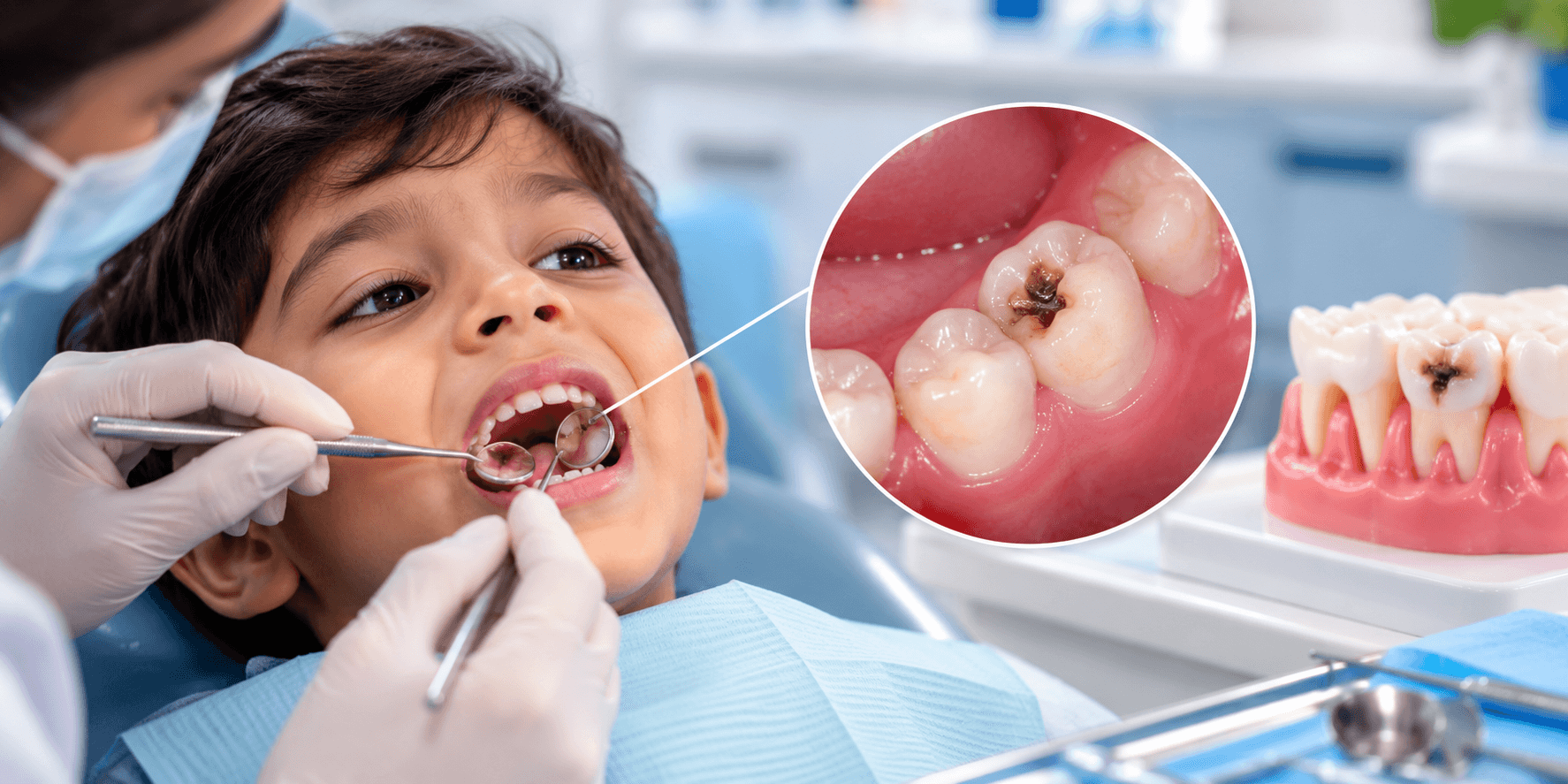
Early decay does not always look like a hole. The first change is often a dull, chalky white area, usually close to the gum or on a back tooth. As decay continues, the spot may turn yellow, brown or dark. In more advanced decay, a visible pit or break in the tooth can appear.
Appearance alone is not a reliable guide, though. Some brown or dark marks are stains and not decay, and some cavities form between teeth or in the grooves of back teeth where a parent simply cannot see them. Only a dental examination can tell what is really going on, so a mark that looks minor is still worth having checked.
Symptoms of Cavities in Milk Teeth
In the early stages, decay may cause no symptoms at all. A child can have a cavity and feel perfectly fine, which is exactly why regular check-ups matter.
When symptoms do appear, they can include:
- sensitivity to cold, hot or sweet foods and drinks
- a toothache, which may come and go at first
- discomfort when chewing, or favouring one side of the mouth
- avoiding certain foods the child normally eats
- food repeatedly getting trapped around one tooth
- disturbed sleep when the pain becomes more significant
Younger children often cannot explain what hurts. They may become irritable, refuse meals or simply say "my tooth feels funny". A persistent complaint about one particular tooth deserves attention.
Swelling of the gum, cheek or face, a pimple-like bump on the gum, or fever alongside tooth pain are different. These can suggest infection and need prompt dental assessment.
Are Cavities in Milk Teeth Serious?
They can be, depending on how far the decay has gone. Early tooth decay is generally easier to manage than decay that has progressed deeper into the tooth. This is the reason parents are encouraged not to wait.
It is tempting to think that because the tooth will fall out anyway, the problem will solve itself. Some milk teeth remain in the mouth for many years before their permanent successors appear, so decay should not simply be left untreated because the tooth is temporary. Untreated decay can lead to pain, difficulty eating, infection, damage to the tooth, and in some cases early loss of the tooth. Depending on the circumstances, an infection in a milk tooth can also affect the developing permanent tooth beneath it.
None of this means every cavity leads to these outcomes. Many are caught and treated before they cause real trouble. The point is simply that a milk tooth with decay is worth taking seriously.
When Should You Take Your Child to a Dentist?
Book a dental appointment if you notice:
- a white, brown or dark spot, or a visible hole
- tooth sensitivity to hot, cold or sweet things
- tooth pain that keeps returning
- trouble eating, or avoiding food they usually enjoy
- one tooth the child keeps complaining about
- sleep disturbed by tooth discomfort
These are reasons for an assessment soon, not an emergency in themselves.
Seek prompt professional attention if there is swelling of the face or gums, significant or worsening pain, fever with dental symptoms, or symptoms that are quickly getting worse. Do not wait for a routine appointment in those cases. If your child is in pain, a dentist or doctor can advise on appropriate pain relief for their age and weight; it is best not to guess at medicines or doses yourself.
Even when everything looks fine, regular dental check-ups help catch problems that cannot be seen at home.
How Is a Cavity in a Milk Tooth Diagnosed?
Diagnosis begins with listening and looking. The dentist will usually ask about symptoms, eating and drinking habits, brushing routines and any earlier dental history. They will then examine the teeth, and may also check the gums, the structure of the affected tooth and, where relevant, how the teeth bite together.
Cavities between teeth or underneath the surface can be difficult to spot by eye. Dental X-rays may be used when the dentist considers them clinically appropriate. They are not needed for every child at every visit; the decision depends on the child's age, risk of decay, symptoms and what the examination shows.
How Are Cavities in Milk Teeth Treated?
Treatment depends on how much decay is present, which tooth is involved, the child's age and cooperation, and other clinical findings. There is no single treatment that suits every tooth, so the options below describe what a dentist may consider and not what any particular child will need.
Early tooth decay
When changes are limited to the outer layer of enamel, a dentist may choose to monitor the tooth closely and focus on preventive measures such as improved brushing, fluoride-based care and diet changes. Early, non-cavitated changes may sometimes be stopped or reversed with appropriate preventive care, depending on the tooth and the stage of decay. A dentist can determine whether monitoring and preventive treatment are appropriate.
Dental fillings
When decay has formed a true cavity, a filling is a common approach. The dentist removes the decayed part of the tooth and fills the space so the tooth can work normally again and is better protected from further decay. The materials and technique used depend on the tooth and the dentist's judgement.
Deeper decay
If decay reaches deeper into the tooth, close to the nerve, a simple filling may not be enough. The dentist may recommend a different approach to treat the inside of the tooth or to rebuild and protect it. Which option makes sense depends on the findings, and your dentist should explain the reasoning to you.
When a milk tooth cannot be restored
Occasionally a tooth is so badly damaged or infected that it cannot be repaired in a predictable way. Extraction may then be considered. It is not a routine first step, and dentists generally prefer to save a milk tooth where it is reasonable to do so.
If a milk tooth is lost early
When a baby tooth is lost well before it would normally fall out, the neighbouring teeth can sometimes drift toward the gap, which may crowd the space meant for the permanent tooth. The dentist may consider whether keeping that space open is appropriate. This is not needed after every extraction; it depends on the tooth, the child's age and how the teeth are developing.
Does Every Cavity in a Milk Tooth Need a Filling?
Not necessarily. Management depends on whether the decay is active, how extensive it is, which tooth is affected and the child's circumstances. Some very early changes may be monitored with preventive care, while established cavities generally need treatment.
It is also not safe to assume a cavity will heal on its own once it has broken through the enamel. A dentist is the right person to say which category a tooth falls into.
What Happens If a Cavity in a Milk Tooth Is Left Untreated?
Decay tends to continue. A small area can enlarge, begin to cause sensitivity or pain, and make eating uncomfortable. If it reaches the inner part of the tooth, bacteria can cause infection, which may lead to swelling or an abscess. The tooth may be damaged beyond repair, and in some cases lost earlier than expected. Because milk teeth sit above developing permanent teeth, the effects can sometimes reach beyond the affected tooth.
How quickly this happens differs from child to child, and it is not possible to predict a timeline. This is why an early check is a sensible step, not a cause for alarm.
How Can You Prevent Cavities in Milk Teeth?
Prevention comes down to a few steady habits.
- Brush twice a day. Use an age-appropriate fluoride toothpaste, and follow your dentist's or national guidance on how much to use for your child's age. Fluoride toothpaste helps protect enamel.
- Help with brushing. Young children usually need an adult to brush for them or finish what they started, and to supervise until they can do it well themselves.
- Clean between touching teeth. Once two of your child's teeth touch, ask your dentist about the best way to clean between them, because a toothbrush may not reach those surfaces.
- Watch how often, not just how much. Keeping sugary foods and drinks mostly to mealtimes, and avoiding repeated sipping of sweet drinks, gives teeth time to recover between acid attacks.
- Make water the everyday drink. It is the simplest choice between meals.
- Avoid sweet drinks at bedtime, after teeth have been brushed.
- Go for regular check-ups. A dentist can spot early changes, advise on your child's specific risk and suggest preventive options where suitable.
- Start early. Habits formed in the toddler years usually carry forward.
Common Myths About Cavities in Milk Teeth
| Myth | What is actually the case |
|---|---|
| Milk teeth do not matter because they fall out | They matter for eating, speaking and guiding the permanent teeth into place for as long as they are present. |
| A cavity only needs attention when it hurts | Decay can be present well before any pain appears. |
| Baby teeth cannot develop serious decay | They can, and some need professional treatment. |
Cavity Treatment for Children at ESD Dental Clinic
If you have noticed a dark spot, a hole, sensitivity or recurring discomfort in your child's milk tooth, a dental examination can help determine whether decay is present and what treatment may be appropriate.
ESD Dental Clinic, also known as e-smyle:Design Dental Clinic, is a dental practice in Hazratganj, Lucknow, established in 2011. You can read about children's dental care at the clinic, or contact ESD Dental Clinic to arrange an examination. The clinic is on the Ground Floor, B Block, Surajdeep Complex, 1-Jopling Road, near Aaj Press, Hazratganj, Lucknow 226001, and the phone number is +91 72669 23333.
Frequently Asked Questions
Can milk teeth get cavities?
Yes. Milk teeth are just as vulnerable to decay as permanent teeth, and their thinner enamel can make decay progress quickly. Plaque, frequent sugar exposure and incomplete cleaning are the usual drivers. Because the teeth are temporary, some parents assume they do not need care, but decay in them can cause pain and infection.
What causes cavities in milk teeth?
Decay develops when plaque bacteria turn sugars into acids that weaken enamel. Frequent sugary foods or drinks, inconsistent brushing, difficulty cleaning back teeth and a higher natural risk of decay can all contribute. Usually it is a combination, so your dentist can help identify which factors apply to your child.
What are the early signs of a cavity in a baby tooth?
Early signs can include a chalky white patch, a brown or dark spot, or mild sensitivity to cold or sweet things. Some children show nothing at all. Because home checks can miss decay, especially between teeth, a dentist's examination is the dependable way to find out.
Can a cavity in a milk tooth heal on its own?
Very early, non-cavitated enamel changes may sometimes be stopped or reversed with appropriate preventive care under a dentist's guidance. Once a true cavity has formed, it should not be expected to repair itself. If you notice a spot or hole, have it assessed instead of waiting.
Does every milk-tooth cavity need a filling?
No. The decision depends on whether the decay is active, how deep it is, which tooth is affected and your child's situation. Some early, non-cavitated changes may be managed with preventive care and monitoring, while a tooth with an established cavity may need restorative or other treatment. Your dentist can explain which applies.
What happens if a baby tooth cavity is left untreated?
The decay may spread, causing pain, trouble eating and sometimes infection. The tooth can become too damaged to repair and may be lost early. The pace varies between children, so early assessment generally keeps treatment simpler.
Can cavities in milk teeth cause pain?
They can, though not always, and not in the early stages. Pain may appear as sensitivity to hot, cold or sweet things, or as an ache that comes and goes. Persistent or worsening pain, or pain with swelling or fever, needs prompt dental attention.
How can parents prevent cavities in milk teeth?
Brush twice daily with age-appropriate fluoride toothpaste, help or supervise until your child can brush well, keep sugary foods and drinks mostly to mealtimes, choose water between meals and book regular dental check-ups. Starting these habits early makes them easier to maintain.
When should a child with a cavity see a dentist?
As soon as you notice a spot, hole, recurring pain or sensitivity, arrange an appointment. If there is facial swelling, significant pain, fever with tooth symptoms or quickly worsening symptoms, seek prompt professional assessment instead of waiting.
Can a cavity in a milk tooth affect permanent teeth?
It can in some circumstances. Infection in a milk tooth may affect the permanent tooth developing underneath, and early loss of a baby tooth can influence how neighbouring teeth move. Not every cavity leads to this, but it is a good reason to have decay checked and treated appropriately.
This article offers general information only. Whether your child's tooth has decay, and what treatment it needs, depends on an individual dental assessment.
References
- American Academy of Pediatric Dentistry. Policy on Early Childhood Caries (ECC): Consequences and Preventive Strategies
- American Dental Association. Baby Teeth (MouthHealthy.org)
- National Institute of Dental and Craniofacial Research. The Tooth Decay Process: How to Reverse It and Avoid a Cavity
- Centers for Disease Control and Prevention. Oral Health Surveillance Report, selected findings
Have a question about this?
Book a consultation and get a straight answer from a dentist — no obligation.